The Principles of Ikebana
Discover in this blog what truly defines Ikebana — and what it takes for individual flowers to become not just an ordinary bouquet, but a graceful, living Japanese arrangement filled with expression and quietness.
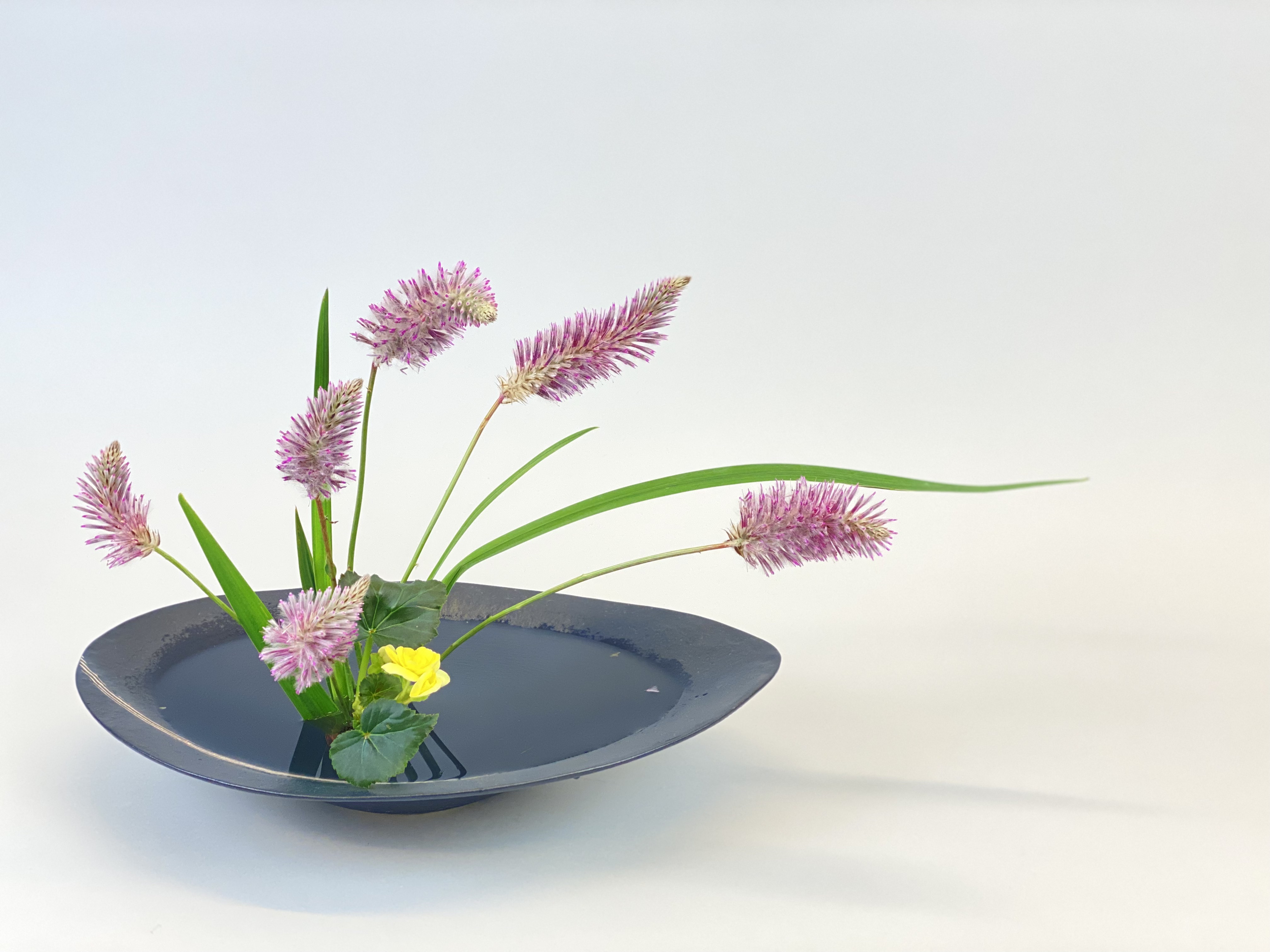
Ikebana is several centuries old and has continuously evolved over time. Different schools emerged as master florists branched off from the main lineage, developed their own styles, and began teaching them. The constant found throughout all of them, whether in classical or modern forms, is the set of underlying principles of this art. The following five principles can be recognised again and again in Ikebana arrangements.
- Space, to allow the beauty of each individual element to unfold
- Asymmetry, to evoke vitality
- Contrast, to express the complementary duality of the universe
- Reduction, to reveal essence and what is essential
- Harmony, as the guiding thread and the ultimate goal of our actions and our being
Space
The fullness of emptiness: Empty space is not “nothing,” but the most important condition for life to unfold at all. In Ikebana, one does not simply arrange flowers — one shapes space. Only through space does what is arranged gain relevance. In Japanese, empty space even has its own word: "Ma". It is a deeply philosophical principle that permeates Ikebana.
This idea differs greatly from traditional Western floristry, where forms are typically emphasised; however, space is becoming increasingly important in modern floristry as well.
Another striking feature of Ikebana arrangements is their sometimes seemingly excessive extension to the eye. This sense of breadth and three-dimensionality results from the “marking out of space.”
Contrast
Contrast is expressed through the well-known principle of Yin and Yang. Complementary opposites, which appear everywhere in life, are woven into Ikebana. The art lies in using plant materials to embody the Yin–Yang principle in such a way that opposites complement one another.
The conscious use of contrast gives Ikebana the dynamism and tension that make it so compelling and engaging as a whole.
Asymmetry
Asymmetry means “not in balance,” “unfinished,” “imperfect” — and it is precisely this that creates an interesting tension. It leaves room for the possibility that something can change. Something in perfect symmetrical balance is static. Asymmetry, on the other hand, allows and even requires development and movement. In this way, this principle is also deeply connected to life.
Playing with varying lengths of branches and flowers is one way asymmetry is expressed in Ikebana.
Reduction
Through minimalism, simplicity, and clarity, the essence is brought to the forefront. This allows the essential nature of each plant to become visible. The challenge lies in recognising this essence — the character of each individual plant — and “translating” it artistically. The aim is to understand the inherent nature of the materials and express it stylistically.
Reduction is achieved by using few materials and removing everything that is unnecessary.
Harmony and Balance
The overarching goal is to create harmony not despite contrast and asymmetry, but through them. While harmony is easy to convey in symmetry, in asymmetry balance must first be created. Only then can a truly complete Ikebana arrangement emerge.
Mindfulness and a trained eye help us find aesthetic harmony — and ultimately, harmony within ourselves.